> For the complete documentation index, see [llms.txt](https://docs.besmart.software/llms.txt). Markdown versions of documentation pages are available by appending `.md` to page URLs; this page is available as [Markdown](https://docs.besmart.software/common-for-several-products/sort-mark/qr-barcode-generator.md).
# QR/Barcode Generator
### Introduction
Sort Mark lets you generate a code as an image based on your selected parameters (you can also crop the values of those parameters, add suffixes, prefixes, etc.).
The images are placed in the **image-type** parameter.
To see the QR codes or barcodes, you need to make a schedule with the image parameter selected and drop that schedule onto a Sheet.
### Workflow
Let’s look at how to implement the QR / Barcode generator in your workflow:
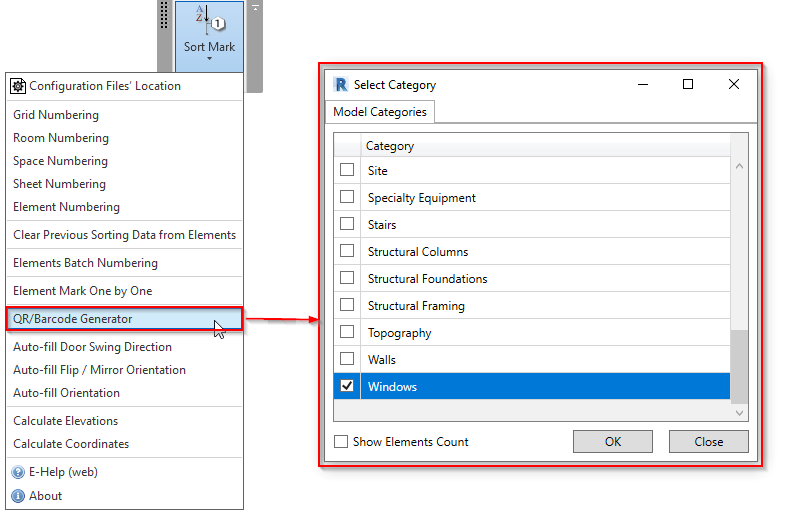
1. First, determine which category of elements should get the QR or barcode. For this example, let's select the Windows category.
2. After selecting the category, you will be prompted with a window asking you to select a parameter where the new QR or barcode should be written. You can create a new shared parameter for the selected category, or use the built-in **Image** instance parameter.

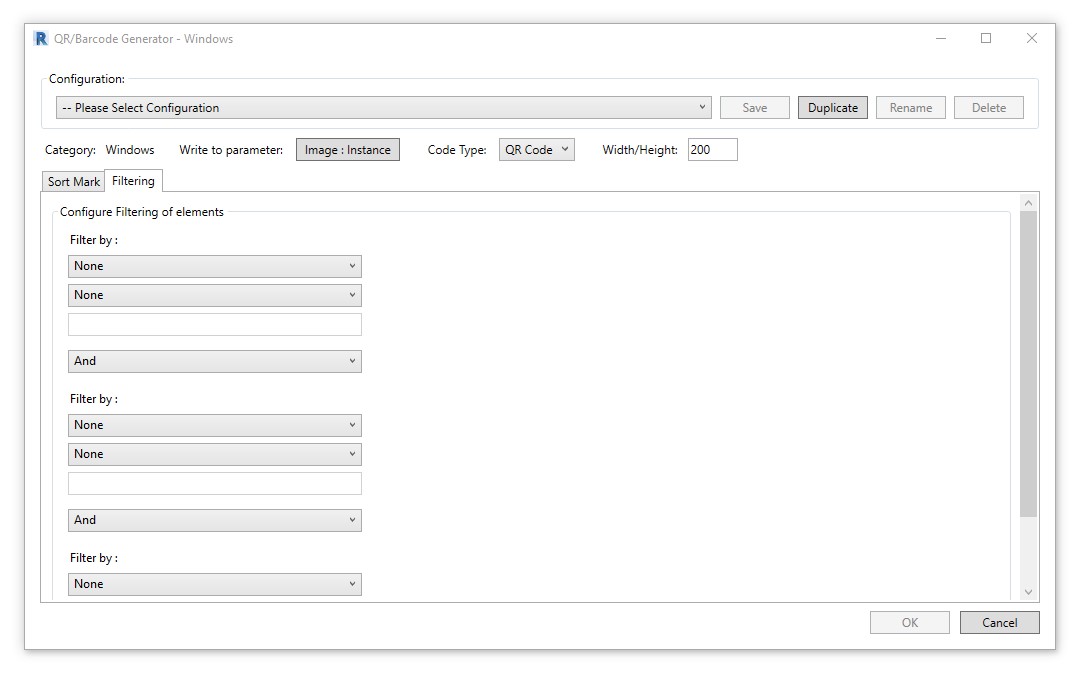
3. After selecting the parameter in which to enter the new QR or barcode values, a configuration window will open where you will need to enter some settings before generating the new codes.
**1 -** Using the menu at the top, you can save your settings for future use.
**2 -** Here you can see the name of the category and the parameter where the code will be created. Here you can choose the **Code Type** (QR or barcode) and the **size of the image** in pixels.
**3 -** In the **Sort Mark tab**, you can select parameters from the left to compose the value of QR codes or barcodes. You can then add a Prefix, Suffix, and Take or Remove segments of the chosen parameter’s value.
In this case, let's select the **Mark: Instance** parameter.

4. In the **Filtering tab**, you can filter out elements from the chosen category, if needed.
5. Click **OK** to run the configuration. An information dialog will show how many elements of the chosen category have been processed.

### Results
Now, when selecting one of the windows, I can see that the QR code was generated as a .png image in the **Image** parameter.

To see the QR codes, I will need to create a schedule and add the **Image** parameter to it.

Finally, let's create a Sheet, place the schedule and the generated QR code is visible.

---
# Agent Instructions
This documentation is published with GitBook. GitBook is the documentation platform designed so that both humans and AI agents can read, navigate, and reason over technical content effectively. Learn more at gitbook.com.
## Querying This Documentation
If you need additional information that is not directly available in this page, you can query the documentation dynamically by asking a question.
Perform an HTTP GET request on the current page URL with the `ask` query parameter, and the optional `goal` query parameter:
```
GET https://docs.besmart.software/common-for-several-products/sort-mark/qr-barcode-generator.md?ask=&goal=
```
`ask` is the immediate question: it should be specific, self-contained, and written in natural language.
`goal` is optional and describes the broader end goal you are ultimately trying to accomplish on behalf of the user. GitBook uses it to tailor the answer towards what is most useful for that goal.
The response will contain a direct answer to the question and relevant excerpts and sources from the documentation.
Use this mechanism when the answer is not explicitly present in the current page, you need clarification or additional context, or you want to retrieve related documentation sections.