> For the complete documentation index, see [llms.txt](https://docs.besmart.software/llms.txt). Markdown versions of documentation pages are available by appending `.md` to page URLs; this page is available as [Markdown](https://docs.besmart.software/common-for-several-products/floor-panel-layout/create-panels.md).
# Create Panels
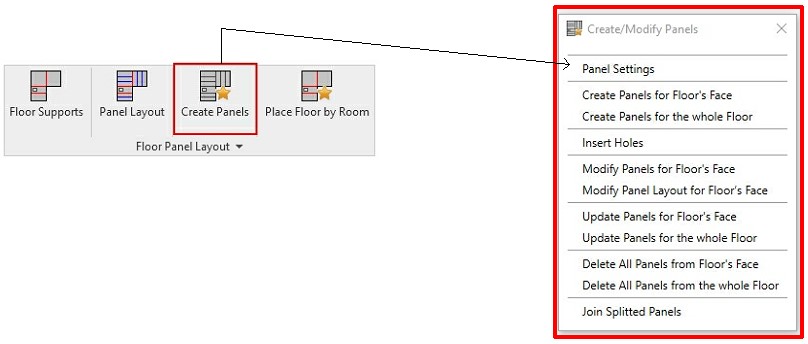
* Select **Create Panels** in the **Floor Panel Layout** menu.
* Select **Panel Settings** from **Create/Modify Panels** menu.

The **Cantilever Offsets from Supports** section lets you define parameters for left/right and start/end cantilevering from structural support for:
* **Unassigned** - use this parameter when floor boundary is not assigned to a Floor Support. Use **Default End Cantilevers (Start/End)** to define offsets for newly created panels.
* **Structural Wall** - use this parameter when floor is assigned to a Floor Support made of structural wall elements. Use this parameter to define start/end offsets from core boundary.
* **Structural Framing** - use this parameter when floor is assigned to a Floor Support made of structural framing elements (i.e. beams). Use this parameter to define start/end offsets from side surface.
* **Grid** - use this parameter when floor is assigned to a Floor Support made of grid elements. Use this parameter to define start/end offsets from grid location line.
**Global Shared Parameters** - software will calculate width and length of floor panels. Assign assembly dimension parameters in Global Shared Parameters. When panels are generated, width, length, height, and depth parameter values will be generated automatically and inserted into corresponding Identity Data fields. You can also create your own parameters.

**Floor Types** - allows you to select which floor type will be used. Penetration holes and type can also be defined.
**Precast Floor** is a floor type which will be used for generating panels. Sizes defined in **Panel Layout Settings** (i.e. panel width) will be the generic layout width. Chosen **Precast Floor** type will be used for generating panels at generic layout widths (e.g. 600mm)
**Cast in Place Floor** is a floor type which will be used when the floor panel layout is an abnormal size (e.g. greater than 600 mm)
**Offset from Level -** allows you to offset **Cast in Place Floor** type from level.
Note**: Precast Floor** type is a level reference point. Offsets will be calculated from **Precast Floor**.
**Hole Types** - software comes with generic penetration hole families. You can modify or create your own new hole families.
Note! Revit Family file name should be same as type name inside.


Once **Panel Layout Settings** and **Create Panel - Panel Settings** are ready, you can **Create Panels for Floor's Face** or **Create Panels for the whole Floor.**
Created panels can further be modified/updated/deleted or joined.


For a faster workflow, you can simply define panel layout and create panels with only a few clicks.


---
# Agent Instructions
This documentation is published with GitBook. GitBook is the documentation platform designed so that both humans and AI agents can read, navigate, and reason over technical content effectively. Learn more at gitbook.com.
## Querying This Documentation
If you need additional information that is not directly available in this page, you can query the documentation by asking a question.
Perform an HTTP GET request on the following URL with the `ask` and `goal` query parameters:
```
GET https://docs.besmart.software/common-for-several-products/floor-panel-layout/create-panels.md?ask=&goal=
```
`ask` is the immediate question: it should be specific, self-contained, and written in natural language.
`goal` is what the user is ultimately trying to achieve, the reason they need the answer. Sharing it helps GitBook give you a better, more relevant answer. A goal is most helpful when it describes the outcome the user wants rather than restating the question. For example, with `ask=how do I create an API token`, a goal like `automate deployments from our CI pipeline` lets GitBook tailor the answer to that use case.
The response will contain a direct answer to the question and relevant excerpts and sources from the documentation.
Use this mechanism when the answer is not explicitly present in the current page, you need clarification or additional context, or you want to retrieve related documentation sections.