> For the complete documentation index, see [llms.txt](https://docs.besmart.software/llms.txt). Markdown versions of documentation pages are available by appending `.md` to page URLs; this page is available as [Markdown](https://docs.besmart.software/3d-modeling-and-design/ventilated-facades/getting-started.md).
# Getting Started
{% hint style="danger" %}
As of **February 2025**, this product has been officially **discontinued** and removed from our portfolio therefore it is **no longer in development**, and no new functionality will be added.
This help page remains available to assist existing users with the current functionality.
{% endhint %}
## Prepare Toolsets for Workflow
Each tool must be prepared before you can start working on Ventilated Facade design and modeling in Revit. Below you will find a step-by-step guidance.
## STEP 1. Download sample files
These sample files will be used for setting up each toolset. You should download these files and save them in a convenient location on your machine:
{% file src="/files/sPcfLTEZR5P4ulzbuXcY" %}
**VF Configurations** - files with 3D modeling and documentation automation rules:
· **ConfigsWall+** - Configurations for Wall+M tool
· **ConfigsSmartConnections** folder - Configurations for Smart Connections
· **ConfigsSmartViews** - Configurations for Smart Views
{% file src="/files/91e4ptb70sykug5Kq1io" %}
**VF Families** - folders contain default ventilated facade families to get you started:
· **Structural Framing** – Metric L, T and other façade structure profiles (imperial soon to be included)
· **Structural Connections** – Metric profile hangers and other fixings (imperial soon to be included)
· **Titleblocks** – Metric A1 sheet template for documentation (imperial soon to be included)
{% file src="/files/ooDV6LqaZ9s5G2GwgxQG" %}
**Revit model** - Metric sample Revit project that will help familiarize with the Ventilated Facades solution (imperial soon to be included)
## STEP 2. Extract files
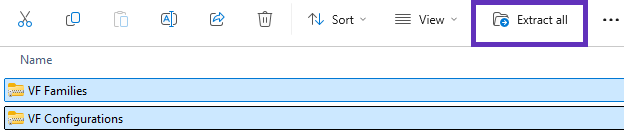
After downloading all folders. Here's an example with the VF Configurations.zip file. Select and extract all files using the Extract all button:
## STEP 3. Open Revit project
Open a new, empty Revit project.
IF YOU WANT TO PRACTICE WITH OUR SAMPLE REVIT PROJECT, THEN **SKIP STEP 4**.
## STEP 4. Load families
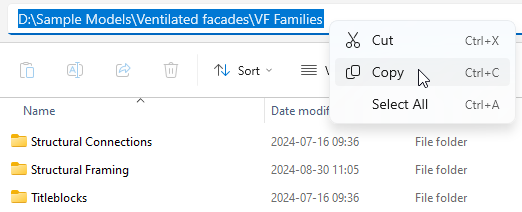
After extracting VF Families ZIP file, copy the **VF Families** folder file path:
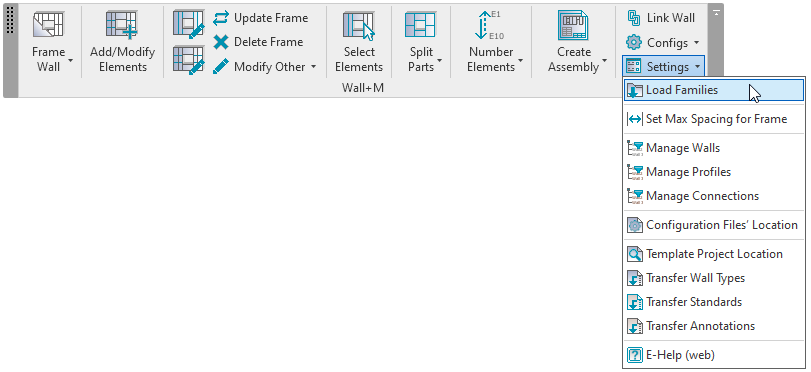
Go back to Revit and find **Wall+M** tool. Open the **Load Families** dialogue:
Paste the file path at the bottom slot:
Before clicking OK, make sure to tick the box under the lower **Load** column:
## STEP 5. Setup configurations
Each tool has unique automation rules (aka configurations). Each tool configuration set has files with written codes. These files should be mapped with each tool.
Follow the steps below (in any order).
### Wall+M
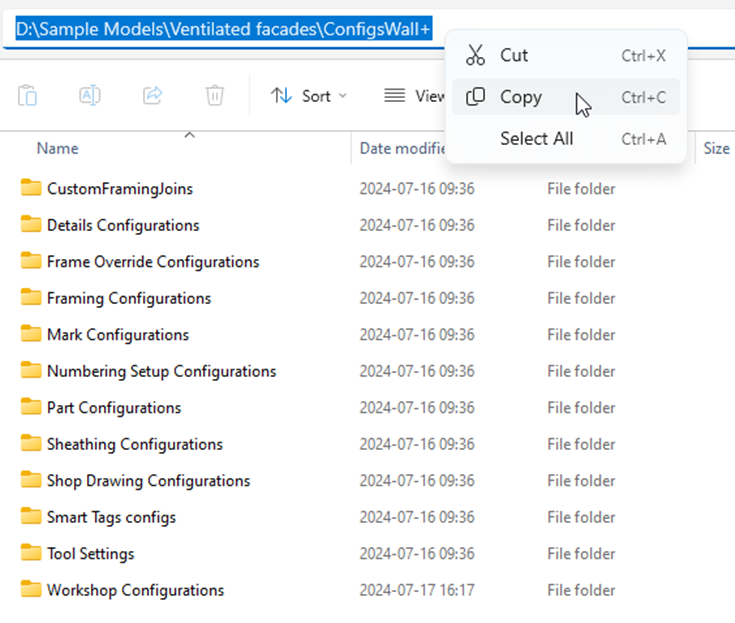
Open **ConfigsWall+M** folder and copy the file path name:
Go back to Revit and find **Wall+M**. Open **Configuration Files' Location** dialogue:
Paste the file path:
### Smart Connections
Open the **ConfigsSmartConnections** folder and copy the file path name. Then go back to Revit and find **Smart Connections tool**. Open **Configuration Files' Location**:
Paste the file path:
### Smart Views
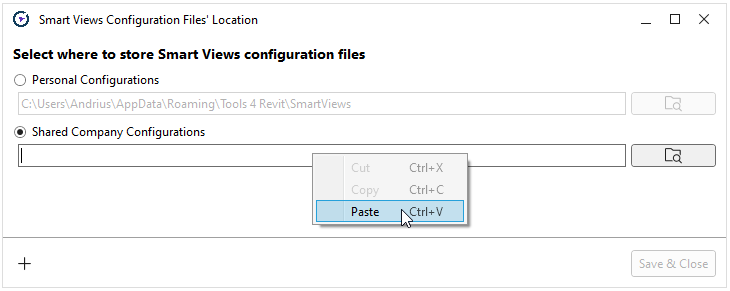
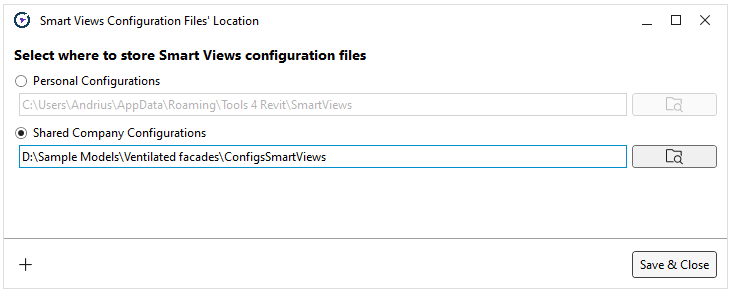
Open the **ConfigsSmartViews** folder and copy the file path name. Then go back to Revit and find the **Smart Views** tool. Open **Smart Views Configuration Files' Location**:
### Smart Views (Smart Dimensions)
You should also copy the file path for the dimensioning rules. Part of the file path is found in Wall+M configuration folders:
Metric: \[...]**ConfigsWall+M**\Shop Drawing Configurations\Dimensions\\**Metric**
Imperial: \[...]**ConfigsWall+M**\Shop Drawing Configurations\Dimensions\\**Imperial**
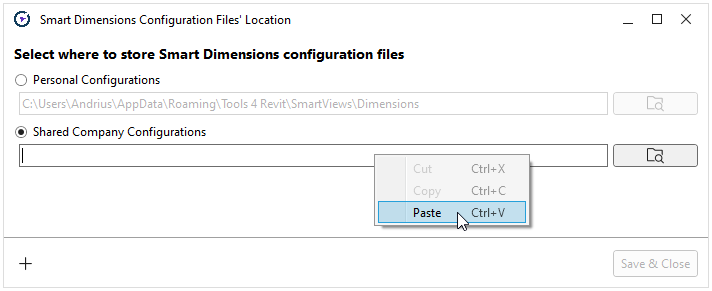
Go back to Revit and open **Smart Dimensions Configuration Files' Location:**
Paste the file path:
---
# Agent Instructions
This documentation is published with GitBook. GitBook is the documentation platform designed so that both humans and AI agents can read, navigate, and reason over technical content effectively. Learn more at gitbook.com.
## Querying This Documentation
If you need additional information that is not directly available in this page, you can query the documentation dynamically by asking a question.
Perform an HTTP GET request on the current page URL with the `ask` query parameter, and the optional `goal` query parameter:
```
GET https://docs.besmart.software/3d-modeling-and-design/ventilated-facades/getting-started.md?ask=&goal=
```
`ask` is the immediate question: it should be specific, self-contained, and written in natural language.
`goal` is optional and describes the broader end goal you are ultimately trying to accomplish on behalf of the user. GitBook uses it to tailor the answer towards what is most useful for that goal.
The response will contain a direct answer to the question and relevant excerpts and sources from the documentation.
Use this mechanism when the answer is not explicitly present in the current page, you need clarification or additional context, or you want to retrieve related documentation sections.